2026 Nissan Sentra Stuns With Fastback Silhouette, More Standard Features
It’s a new dawn for Nissan’s popular compact sedan
Nissan has finally pulled the wraps off the all-new Sentra, hoping to win over buyers with its radical new shape, intriguing standard features, and polarizing style, which echoes that of the recently unveiled 2026 Nissan LEAF and the massively updated Nissan Murano. Now available in four different flavours: S, SV, SR, and SL, the 2026 Nissan Sentra’s apparent aim is to appeal to a broad and diverse array of customers, offering up everything from frugal functionality to thrifty thrills and even a touch of luxury.
The Sentra’s success is imperative for Nissan
Originally introduced to American buyers in 1982, the Sentra is one of Nissan’s longest-standing models, and in fact was one of the first ever models sold under the Nissan name after rebranding from Datsun. Since then, the Sentra has gone head-to-head against some serious competition, such as the Toyota Corolla and the Honda Civic, and has remained one of Nissan’s best-selling models in North America to this very day. Even as crossovers have become the obvious mainstream within the automotive marketplace, Nissan is convinced that the compact sedan segment still sees consistent growth in terms of sales volume, and that this growth is likely to continue throughout the lifespan of the Sentra’s latest generation. Nissan hopes that the new 2026 Nissan Sentra will carry on the torch held proudly by the generations before it, and I think their focus on “evolution, not revolution” is a well-calculated strategy that is sure to pay off with long-time Sentra loyalists and new-to-Nissan buyers alike.
A radical new shape keeps things fresh, at least visually
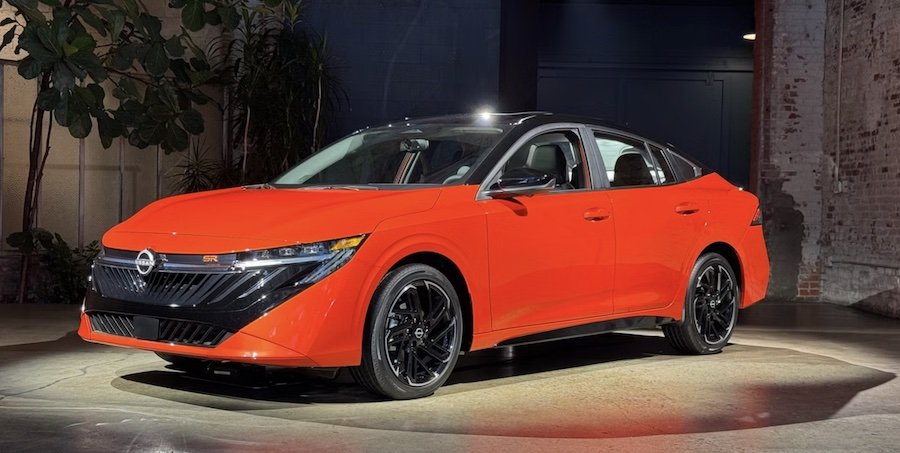
When first seeing the all-new 2026 Nissan Sentra, the fastback-esque roofline immediately caught my attention. Clearly inspired by the popularity of European models sold with clever naming schemes like “gran coupe” and “sportback,” the latest Sentra aims to move away from the traditional “three box” shape that sedans have traditionally remained synonymous with, instead displaying a sportier and more modern interpretation of what a four-door economy saloon should look like. Nissan’s also made significant enhancements to the rear end to make the trunk more easily accessible. Although it lacks a high-opening tailgate that you might expect from its new fastback silhouette, the 2026 Sentra’s trunk opening is now 50MM wider than that of its previous generation, and its loading height is much lower, too. Nissan hopes this could save you money on delivery costs, but don’t count on being able to load a refrigerator or a large TV into the boot any time soon. It will, however, make it much easier for your Uber driver to load up your suitcases, which is where I anticipate it’ll matter most.
As for its styling, I must admit I’m pretty fond of the Nissan design team’s work here. Its striking new LED headlights have Audi-like animations to welcome you and bid you farewell, and the SR trim’s 18-inch wheels and black contrast roof give it a seriously racy appearance. Vibrant new paint colors such as the SR’s “Energetic Ember” and the SL’s “Imperial Bronze” set a light-hearted tone, signalling a much-appreciated departure from the typical dullness of grey, black, and white paint.
Yes, the Sentra’s new front end does bear a striking resemblance to that of the upcoming, third-generation Nissan LEAF. Still, truth be told, the third-gen LEAF is the first ever LEAF that made me think, “Well, if I must be subjected to driving fifteen under the limit in the passing lane behind a LEAF, at least this one doesn’t look half bad.” Maybe that’s only my personal experience, but regardless, I give my props to Nissan’s designers for having some actual fun with the styling of the brand’s latest models, and I think the automaker’s latest design language is a significant step in the right direction towards revitalizing the brand through its heavily publicized recent financial struggles.
Moving inside, the 2026 Nissan Sentra’s interior is aptly modernized, clean and crisp, and thankfully doesn’t just rely on one big screen slapped onto the center of the dash for every one of its controls. While the Sentra does gain dual 12.3-inch displays, mounted in such a way that doesn’t at all remind me of the Mercedes-Benz CLA-Class, the dashboard also includes capacitive touch switches for its climate controls, and an actual mechanical shifter, even if it is just so switch its continuously variable automatic transmission from “park” to “drive.” Nissan’s “Zero Gravity” seats, designed around how an astronaut would sit when weightless in outer space, are now standard across the entire Sentra lineup and supposedly reduce fatigue during long trips. Additionally, a surround-view camera system is now standard equipment on the Sentra, as well as a slew of driver assist features, including active blind spot intervention.
Despite its unrecognizable appearance, the 2026 Nissan Sentra holds onto familiar underpinnings
Although I was eagerly hoping the new Nissan Sentra would be blessed with the well-regarded ePower hybrid system available in overseas market products, or even that a driver-focused variant could pair the 201-horsepower, 1.5-liter VC-Turbo engine found in the Rogue with a manual transmission to take on the Honda Civic Si, the 2026 Nissan Sentra will, in fact, carry over its beating heart from its previous generation. That’s not necessarily bad news, though, as the Sentra’s 2.0-liter inline-four with direct injection is a stout performer in the efficiency department, achieving up to 40 highway miles per gallon in the 2025 Sentra. Its power figures are, well… fine. With 149 horsepower and 146 lb-ft of torque on tap, delivered to the front wheels through Nissan’s Xtronic CVT transmission, the all-new Sentra certainly won’t blow the doors off of much, but that’s not at all what it’s for. Although a hybrid powertrain could have boosted power while simultaneously enhancing fuel efficiency, retaining the Sentra’s tried-and-tested 2.0-liter straight-four engine should keep costs down, meaning the Sentra should be a bargain relative to pricier hybrid-powered rivals.
Final thoughts
Although the 2026 Nissan Sentra carries over much of its mechanical equipment from its previous generation, it demonstrates Nissan’s profound and practical efforts to enhance the desirability of its models by focusing on material quality and employing a visually striking updated design language. Its new styling is aggressive and modern, even if it does look a bit like a Peugeot, and its fastback silhouette reminds my eyes of the Acura Integra—an effect I anticipate it’ll have on potential buyers who might mentally conflate its proportions with pricier vehicles. The all-new Sentra follows the lead of Nissan’s all-new LEAF, which demonstrates a similar example of improved attention to detail and material quality from a brand that desperately needs to win back buyers, and is a step in the right direction towards Nissan’s financial recovery.
Related News
