Waymo's Autonomous Cars Panicked During Power Outage And Bricked Themselves
Traffic Lights Went Out, And So Did AI
It wasn't some Italian Job-style plot to swap out the tapes for the traffic control computers. Instead, it was something that happens all of the time. The power went out. A fire at a San Francisco-area power substation on Saturday afternoon left more than 100,000 customers without power. That put traffic lights out across San Francisco, and it put Waymo's self-driving taxis into panic mode.
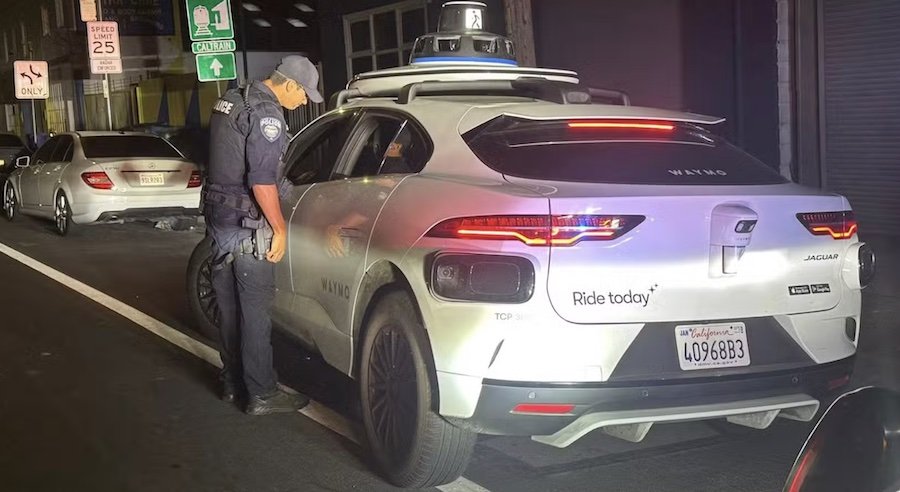
We know that human drivers can have a tough time remembering that a broken traffic light is a four-way stop, but somebody evidently forgot to tell Waymo's AI that rule. So instead of yielding and proceeding as they should, the cars just stopped. All over the city, often in the middle of intersections, the Waymo vehicles came to a halt with their four-ways on and nobody home.
Waymo seems to be blaming the problem not on a lack of training for the driving model, but on the level of the event. "While the Waymo Driver is designed to treat non-functional signals as four-way stops, the sheer scale of the outage led to instances where vehicles remained stationary longer than usual to confirm the state of the affected intersections," a Waymo spokesperson said in a statement provided to the BBC.
It seems that when every car is asking the network about a special condition at the same moment, it overloads and brings them all to a stop. The company claims that "the majority" of its active rides were completed before the cars pulled over. One social media user posted six Waymo Jaguars at one intersection, blocking the road.
Waymo Is Looking To Expand To More Cities
The issue happened just days after Waymo announced it had reached 20 million fully-autonomous trips. The autonomous vehicle company has recently touted its more than 100 million fully autonomous miles, claiming it had a "more than ten-fold reduction" in crashes with serious injuries versus human drivers and that it had "demonstrably safe AI for autonomous driving.
In November, Waymo announced it was adding autonomous driving in five new cities. Miami, Dallas, Houston, San Antonio, and Orlando. Each city requires significant extra work for its Driver AI. What does that extra work entail? Waymo calls it "nuances" though most drivers might think of it as "that intersection that's always a mess." Basically, its locations that can sometimes be a little tricky to deal with. Those situations have to be encountered, and then the system is told what to do when it gets there.
Waymo is still the current leader in autonomous ride-hailing vehicles. It has cars on the road without drivers in Phoenix, LA, Atlanta, and Austin, as well as San Francisco. The company hopes to launch in Tokyo and London next year.
Subscribe to our newsletter for smart-vehicle insights
Curious how incidents like autonomous fleets stalling unfold? Subscribe to the newsletter for careful coverage and expert context on self-driving technology, urban infrastructure, and the policy and safety issues that matter.
Subscribe
Curiously, Tesla CEO Elon Musk posted to his social media platform X that "Tesla Robotaxis were unaffected by the SF power outage." It's curious because Tesla does not offer a driverless autonomous vehicle service in the area. So technically, this is a correct statement. Take that as you will.
There were no reported injuries as a result of the malfunction. There are still power outages around the city, and some government offices remain closed. However, the Waymo vehicles are back on the road.
Related News
