Key Points
- The Mazda 6e blends Mazda design with Chinese underpinnings.
- It impresses with premium materials, strong practicality, and competitive charging,
- More than a one-off, the 6e signals Mazda’s growing reliance on global partnerships to stay relevant.
Has Mazda Finally Committed to EV Tech?
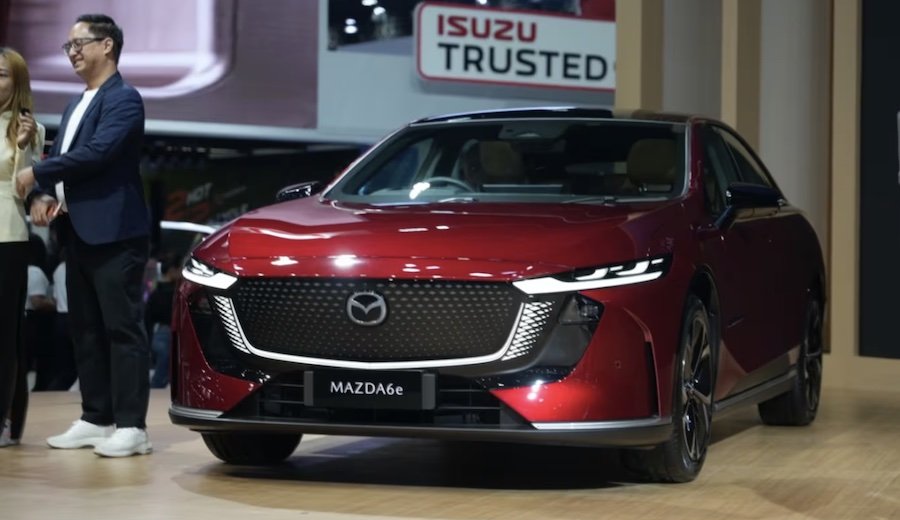
Mazda has been hesitant, to say the least, when it comes to electrification. For years, the brand has leaned on its Jinba Ittai philosophy, prioritizing driver engagement over outright technological leaps. Hybrids came late, full EVs even later. But at the 47th Bangkok International Motor Show, that resistance finally felt like it was cracking. Seeing the 2026 Mazda 6e in the metal, it’s clear Mazda is testing how far it can stretch that philosophy into the electric era.
What makes the 6e fascinating is that it doesn’t pretend to be a clean-sheet Mazda. Underneath, it shares its architecture with the Deepal L07 from Changan Automobile. Same platform, same battery fundamentals, same core EV package.
But Mazda has gone to great lengths to make it feel like its own. The proportions, the surfacing, even the stance carry familiar cues. It’s not just badge engineering. It’s Mazda interpreting someone else’s hardware through its own design lens.
Mazda on the Outside, Something Else Inside
Up close, the redesign effort is obvious. Every exterior panel has been reworked, highlighted by a new front fascia and slim split LED lighting with daytime running lights up top and the main beams tucked below. It’s a clean evolution of Mazda’s design language. The silhouette adds another layer of intrigue.
What looks like a conventional sedan is actually a five-door hatchback, with a coupe-like roofline flowing into a full tailgate. The payoff is real usability: 16 cubic feet of cargo space expands to over 35 cubic feet with the seats folded, plus a small frunk up front.
Inside, Mazda leans heavily into tech. A 14.6-inch touchscreen dominates and controls nearly everything, paired with a 10.2-inch digital cluster and an augmented reality head-up display. Material quality remains a strong point, with suede-like trim, soft-touch surfaces, and a standard panoramic roof. But there are compromises. The battery raises the floor, forcing a slightly knees-up seating position in the rear compared to rivals like the Tesla Model 3 and Volkswagen ID.7.
This collaborative approach isn’t new either, with models like the Mazda CX-50 Hybrid already borrowing Toyota tech, and future projects like a reworked Deepal E07 signaling that the 6e is less a stopgap and more a preview of Mazda’s partnership-driven future.
A Different Kind of EV Strategy
The powertrain is competitive if not class-leading. A 68.8 kWh lithium iron phosphate battery feeds a rear-mounted motor producing 258 horsepower and 236.0 lb-ft of torque. Performance is respectable, with 0–100 km/h in 7.6 seconds and a WLTP range of 479 km. Charging is where it punches above its weight. On a 165 kW DC fast charger, it can go from 10 to 80 percent in just 24 minutes, putting it in the conversation with more expensive EVs like the BMW i4.
Walking the show floor in Bangkok, it’s clear this isn’t just about one car. Thailand is becoming a critical hub for electrification, not just for Mazda but for the broader industry.
The 6e reflects how seriously the brand is taking that shift. It’s leaning into partnerships to bridge gaps in engineering and scale, while preserving its driver-first identity. Whether that balance holds on the road is still an open question, and the 6e feels like a serious turning point.
