Mamma Mia, Why Is Ferrari Benchmarking This Chinese Record-Breaker?
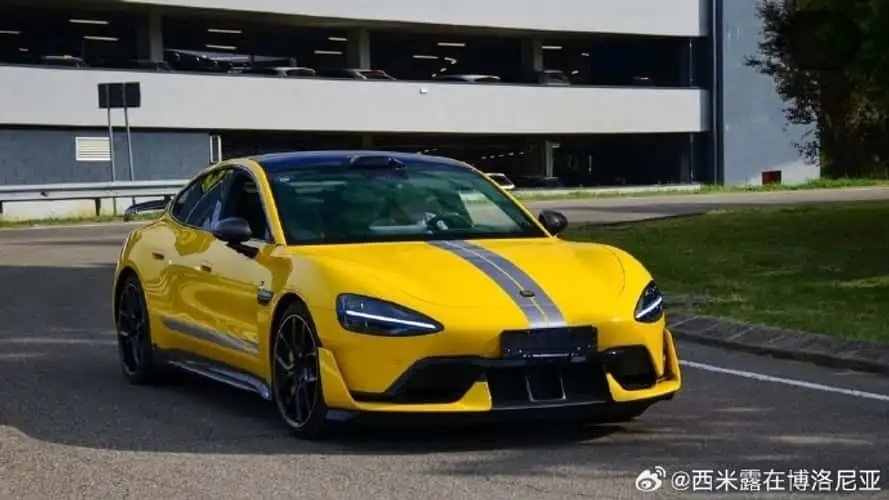
Ferrari’s first-ever electric vehicle, the tentatively-named Elettrica, is due to be unveiled later this year, with a second, albeit now delayed, crossover EV expected to follow in 2028.
Why Ferrari Is Benchmarking Against A Rival No One Expected
Though it’s tempting to speculate that a Ferrari-Xiaomi technical partnership might be in the offing – the latter’s CEO Lei Jun was recently spotted sporting a Ferrari Purosangue SUV – it’s not uncommon for manufacturers to borrow models from rival manufacturers for inspiration and/or engineering shortcuts. Still, while the Scarlet Horse’s literal track record proves its fleet of engineers knows how to produce a sports car and/or crossover with perfect handling, and though the 296 GTB and the SF90 Stradale also prove Ferrari is equally adept at hybrid propulsion, an all-electric platform and its various pitfalls is uncharted territory for Maranello.
Arguably few models could prove more useful in this regard than the SU7. Powered by three electric motors, Xiaomi’s flagship produces a staggering 1,526-horsepower – almost 350 hp more than the F80 – and 1,305-pound feet of immediate torque, ensuring a sub-two-second sprint from a standstill to 62 mph. Moreover, in June, the production EV stunned the motoring world by setting a Nürburgring Nordschleife lap time of 7 minutes, 4.95 seconds. To give that some proper context, it's faster than combustion cars like the Nissan GT-R Nismo and McLaren 720S. In the electric world, it beat the 1,914-hp Rimac Nevera. So yeah, it's fast.
So far, few official details have been unveiled about Ferrari’s first-ever electric vehicle, with an overview of the “technological heart” only due to be released on October 9. It’s highly likely though that the new Elettrica will be built in-house at a new E-building that will start operations with the Purosangue and SF90 before the EV starts rolling out in 2026. It is believed this will help Ferrari reduce development time and make personalization more flexible for customers. Down the line, production of all Ferrari EV powertrains, including batteries and motors, is expected to be done in the E-Building.
Test mules with all-electric architecture have also been snapped with modified Maserati Levante bodywork. It is believed, much like BMW’s upcoming iX3, that the batteries will be centralized and will form part of the platform itself in a bid to optimize weight distribution and the center of gravity. Though this will not be clarified until well into next year, prices are expected to hover around the half-million dollar mark.
Related News
