General Motors Isn't Slowing Down On Battery Development
They're said to deliver more range, shorter charge times, lower costs, and improved safety compared to current liquid-type batteries. As a result, many automakers are actively researching the technology, with some, such as Mercedes-Benz and Nissan, promising it for production later this decade.
General Motors, which has one of the most diverse lineups of EVs and batteries that punch out some impressive segment-leading range capabilities, has now revealed it's researching solid-state technology in a quest to extend its lead, though it remains cautious.
Solid-State Just One Solution For Next-Gen Batteries
In a recent interview with InsideEVs, Kushal Narayanaswamy, who heads GM's advanced battery cell engineering department, said the automaker was researching solid-state technology but hasn't decided on commercialization. Part of the reason is that GM is looking at solid-state batteries alongside other promising solutions such as sodium-ion batteries.
As the name suggests, solid-state batteries use a solid electrolyte instead of the liquids or gels that most EV batteries use today. One of the benefits is that the batteries are less prone to overheating and catching fire and less susceptible to extreme temperatures, thus improving safety and removing the necessity for complex cooling systems. They are also denser, meaning a solid-state battery would be smaller and lighter than a liquid-type battery with a comparable kilowatt-hour capacity.
In addition to solid-state and sodium-ion battery technology, Narayanaswamy said GM is also researching as many as seven different anode and cathode chemistries. These are the parts of the battery where chemical reactions take place to either deliver or store electrical energy. Only a month ago, GM said it had developed a battery with a manganese-rich cathode. Manganese is an abundant metal that costs considerably less than traditional cathode materials like nickel and cobalt, and thus has the potential to reduce battery prices.
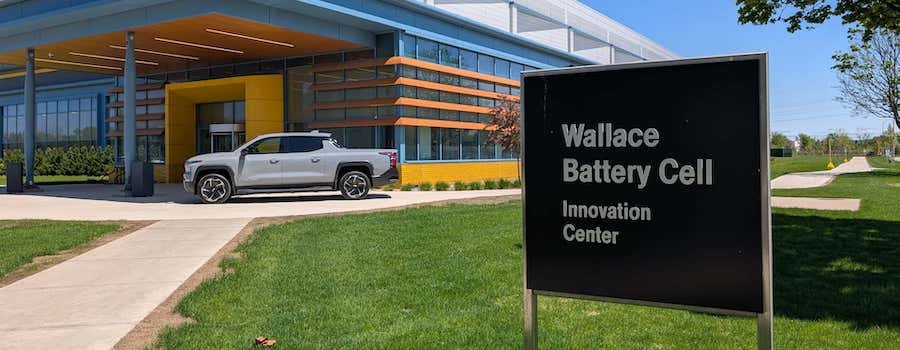
GM's Wallace Battery Cell Innovation Center In Warren, MichiganGeneral Motors
Before GM commits to putting solid-state batteries into production, the automaker will likely pursue sodium-ion batteries, which use a liquid-type electrolyte similar to lithium-ion batteries. In his interview with InsideEVs, Narayanaswamy said GM has the technical know-how to produce sodium-ion batteries but needs to ensure the right application and the necessary supply chains are in place.
Sodium-ion batteries have a lower energy density than even lithium-ion batteries on sale today, but because they use abundant sodium, they also have the potential to reduce prices significantly. Some Chinese automakers have already started offering EVs with sodium-ion batteries. Chinese battery giant CATL, which is opposed to solid-state batteries, revealed its first sodium-ion battery earlier this year.
Work on GM's batteries is handled at the Wallace Battery Cell Innovation Center, which the company opened in 2022 at its sprawling technical center in Warren, Michigan. The center enables GM to develop and test new chemistries and cells in-house, leading to faster development times and greater oversight across the full chain – from choosing raw materials to designing battery cells and integrating them into the vehicle.
Related News
