Alfa's Ferrari-Derived V6 Is Back, Baby! But There's A Catch
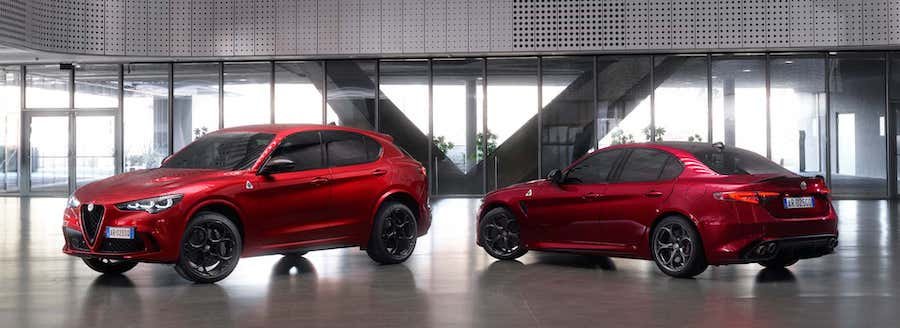
You may not have noticed that they were gone, but Alfa Romeo – like most brands in the Stellantis fold – was, until recently, preparing for a fully electric lineup before the end of the decade. Part of that preparation included killing off the Giulia and Stelvio Quadrifoglio, along with their Ferrari-derived twin-turbocharged 2.9-liter V6 engine. US sales ended in mid-2024, while the rest of the world saw sales end in March of this year.
However, Alfa execs had already started hinting at the return of the Quadrifoglios and their V6 shortly after production ceased. That's because Alfa Romeo came to accept that the take-up rate for electric vehicles wasn’t accelerating as quickly as forecast, and it promised at the start of 2025 that its lineup would continue to offer internal-combustion vehicles (mostly hybrids) alongside electric models for the foreseeable future. That promise starts with the new Quadrifoglio Collezione.
Alfa Romeo's Quadrifoglio logo, symbolized by a four-leaf clover, dates back to 1923, when Ugo Sivocci won the Targa Florio in an Alfa Romeo RL featuring it. It then reappeared on multiple Alfa Romeo race cars in the decades that followed, and finally made the transition to road cars when Alfa Romeo launched the Giulia Ti Super homologation special in 1963. It’s in honor of this first road-going Quadrifoglio that Alfa Romeo has limited the new Quadrifoglio Collezione to 63 units.
Unique to the cars is their red paint, inspired by the Rosso Villa d’Este finish that appeared on the iconic 33 Stradale sports car of the 1960s (not the recently launched supercar of the same name). There’s Rosso Collezione Giulia for the sedan and Rosso Collezione Stelvio for the crossover. The paint carries a deep red tint that almost shifts to black depending on the light, with the Giulia’s version appearing extra dark.
Elsewhere, the cabin wraps you in leather and red stitching, with numbered leather-and-Alcantara seats – each marked “1 di 63 Collezione” – underscoring the rarity of the special editions. Sparco buckets with carbon-fiber shells join a leather-trimmed armrest and door panels for a more focused feel. More carbon appears outside, including on the badges, mirror caps, and the roof, while carbon-ceramic brake rotors are standard.
There’s no extra power on tap, so the twin-turbo V6 – partially developed by Ferrari and sharing design DNA with the F136 V8 used in the 458 Italia, California, and Maserati GranTurismo – remains rated at 520 horsepower and 443 pound-feet of torque. In the US, the engine carried a slightly lower 505-hp output. An Akrapovic exhaust system is standard on the special editions. Drive goes to the rear wheels in the sedan and all four in the crossover.
Alfa Romeo hasn't said whether more Giulia and Stelvio Quadrifoglios will be built beyond the 63 Quadrifoglio Collezione specials. The brand also hasn't said whether the Giulia or Stelvio Quadrifoglio will return to the US in their current form.
An electric next-generation Stelvio was originally scheduled for 2025, followed by an electric next-generation Giulia in 2026. However, both have been delayed by a couple of years as engineers work to add an ICE option. As a result, the current Giulia and Stelvio will remain in production through 2027 – and likely the Quadrifoglio versions, too. This means there's a good chance the current Quadrifoglios will eventually make their way to the US.
