2026 Hyundai Palisade Falls Short in IIHS Crash Test
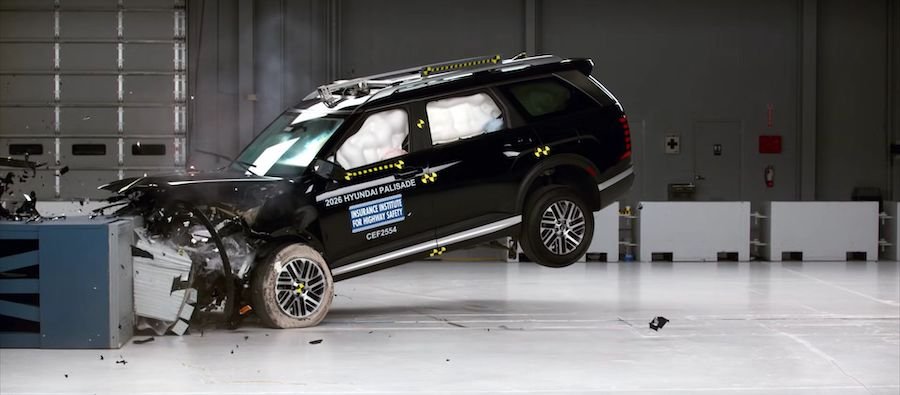
As you can see from the video published on the nonprofit organization's YouTube channel, the rear passenger dummy's head remained a safe distance from the driver's seatback. Dummy sensors indicate a low risk of injury to the neck as well, and during the crash, the shoulder belt remained in its ideal position.
The lap belt, on the other hand, moved from the pelvis to the abdominal area, translating to an increased risk of abdominal injuries. The moderate overlap test sees 40 percent of the vehicle's total width striking a deformable barrier on the driver's side at 40 miles per hour, which converts to 64 kilometers per hour.
Regarding the dimensions of the crash test dummies, the IIHS uses 5th percentile female dummies in the rear seat to ensure that the vehicle's safety systems are effective for people who aren't average-sized men. While front-seat safety has improved dramatically in the past decade, the risk of fatal injury for rear belted occupants is quite a bit higher.
Because of the lap belt's movement, the Palisade received an acceptable rating instead of the coveted good rating. And that's a bit humbling for Hyundai, whose redesigned Palisade has been showered with good ratings by the IIHS.
Beyond the small overlap and side tests, good ratings further apply to the headlights, front crash prevention, LATCH system, and the seatbelt reminders. Longer than its predecessor, the Palisade comes with either seven- or eight-passenger seating.
The SE, SEL, and SEL Premium feature eight seats by default, with captain's chairs being optionally available on the SEL and SEL Premium. The seven-seat layout is standard on the XRT Pro, Limited, and Calligraphy, which do not offer an eight-seat option.
Produced in South Korea rather than the United States of America for the mechanically similar Kia Telluride, the Hyundai Palisade comes with either 3.5-liter naturally aspirated V6 or 2.5-liter turbo I4 muscle. The latter is exclusively hybrid. In addition to a starter-generator unit, the second motor is neatly integrated into the tranny to provide tractive force.
Connected to a 1.65-kW battery that operates at 300 volts, the P2 motor delivers up to 72 horsepower. The combined rating for this powertrain is 329 hp and 339 lb-ft (460 Nm) as opposed to 287 hp and 260 lb-ft (353 Nm) for the free-breathing V6 engine.
With front-wheel drive, the standard sixer promises up to 21 miles per gallon (11.2 liters per 100 kilometers) on the combined test cycle. Switching to AWD means either 20 or 21 mpg, figures that convert to 11.8 and 12.4 l/100 km in metric speak.
Also available with all-wheel drive, the hybrid nets anything from 34 mpg (6.9 l/100 km) to 29 mpg (8.1 l/100 km). The most efficient Palisade Hybrid configurations are the Blue and SEL Premium with front-wheel drive.
Related News
